secml.ml.classifiers.reject
CClassifierReject
-
class
secml.ml.classifiers.reject.c_classifier_reject.CClassifierReject(preprocess=None)[source]¶ Bases:
secml.ml.classifiers.c_classifier.CClassifierAbstract class that defines basic methods for Classifiers with reject.
A classifier assign a label (class) to new patterns using the informations learned from training set.
This interface implements a set of generic methods for training and classification that can be used for every algorithms. However, all of them can be reimplemented if specific routines are needed.
- Parameters
- preprocessstr or CNormalizer
Features preprocess to applied to input data. Can be a CNormalizer subclass or a string with the desired preprocess type. If None, input data is used as is.
- Attributes
class_typeDefines class type.
classesReturn the list of classes on which training has been performed.
loggerLogger for current object.
n_classesNumber of classes of training dataset.
n_featuresNumber of features (before preprocessing).
preprocessInner preprocessor (if any).
verboseVerbosity level of logger output.
Methods
backward(self[, w])Returns the preprocessor gradient wrt data.
copy(self)Returns a shallow copy of current class.
create([class_item])This method creates an instance of a class with given type.
decision_function(self, x[, y])Computes the decision function for each pattern in x.
deepcopy(self)Returns a deep copy of current class.
estimate_parameters(self, dataset, …[, …])Estimate parameter that give better result respect a chose metric.
fit(self, dataset[, n_jobs])Trains the classifier.
forward(self, x[, caching])Forward pass on input x.
get_class_from_type(class_type)Return the class associated with input type.
get_params(self)Returns the dictionary of class parameters.
get_state(self)Returns the object state dictionary.
get_subclasses()Get all the subclasses of the calling class.
grad_f_x(self, x, y)Computes the gradient of the classifier’s decision function wrt x.
gradient(self, x[, w])Compute gradient at x by doing a backward pass.
is_fitted(self)Return True if the classifier is trained (fitted).
list_class_types()This method lists all types of available subclasses of calling one.
load(path)Loads object from file.
load_state(self, path)Sets the object state from file.
predict(self, x[, return_decision_function, …])Perform classification of each pattern in x.
save(self, path)Save class object to file.
save_state(self, path)Store the object state to file.
set(self, param_name, param_value[, copy])Set a parameter of the class.
set_params(self, params_dict[, copy])Set all parameters passed as a dictionary {key: value}.
set_state(self, state_dict[, copy])Sets the object state using input dictionary.
timed([msg])Timer decorator.
-
abstract
predict(self, x, return_decision_function=False, n_jobs=1)[source]¶ Perform classification of each pattern in x.
If a preprocess has been specified, input is normalized before classification.
- Parameters
- xCArray
Array with new patterns to classify, 2-Dimensional of shape (n_patterns, n_features).
- return_decision_functionbool, optional
Whether to return the decision_function value along with predictions. Default False.
- n_jobsint, optional
Number of parallel workers to use for classification. Default 1. Cannot be higher than processor’s number of cores.
- Returns
- labelsCArray
Flat dense array of shape (n_patterns,) with the label assigned to each test pattern. The classification label is the label of the class associated with the highest score. The rejected samples have label -1.
- scoresCArray, optional
Array of shape (n_patterns, n_classes) with classification score of each test pattern with respect to each training class. Will be returned only if return_decision_function is True.
CClassifierRejectThreshold
-
class
secml.ml.classifiers.reject.c_classifier_reject_threshold.CClassifierRejectThreshold(clf, threshold, preprocess=None)[source]¶ Bases:
secml.ml.classifiers.reject.c_classifier_reject.CClassifierReject- Abstract class that defines basic methods for Classifiers with reject
based on a certain threshold.
A classifier assign a label (class) to new patterns using the informations learned from training set.
The samples for which the higher score is under a certain threshold are rejected by the classifier.
- Parameters
- clfCClassifier
Classifier to which we would like to apply a reject threshold. The classifier can also be already fitted. In this case, if a preprocessor was used during fitting, the same preprocessor must be passed to the outer classifier.
- thresholdfloat
Rejection threshold.
- preprocessCPreProcess or str or None, optional
Features preprocess to be applied to input data. Can be a CPreProcess subclass or a string with the type of the desired preprocessor. If None, input data is used as is.
- Attributes
class_typeDefines class type.
classesReturn the list of classes on which training has been performed.
clfReturns the inner classifier.
loggerLogger for current object.
n_classesNumber of classes of training dataset, plus the rejection class.
n_featuresNumber of features (before preprocessing).
preprocessInner preprocessor (if any).
thresholdReturns the rejection threshold.
verboseVerbosity level of logger output.
Methods
backward(self[, w])Returns the preprocessor gradient wrt data.
copy(self)Returns a shallow copy of current class.
create([class_item])This method creates an instance of a class with given type.
decision_function(self, x[, y])Computes the decision function for each pattern in x.
deepcopy(self)Returns a deep copy of current class.
estimate_parameters(self, dataset, …[, …])Estimate parameter that give better result respect a chose metric.
fit(self, dataset[, n_jobs])Trains the classifier.
forward(self, x[, caching])Forward pass on input x.
get_class_from_type(class_type)Return the class associated with input type.
get_params(self)Returns the dictionary of class parameters.
get_state(self)Returns the object state dictionary.
get_subclasses()Get all the subclasses of the calling class.
grad_f_x(self, x, y)Computes the gradient of the classifier’s decision function wrt x.
gradient(self, x[, w])Compute gradient at x by doing a backward pass.
is_fitted(self)Return True if the classifier is trained (fitted).
list_class_types()This method lists all types of available subclasses of calling one.
load(path)Loads object from file.
load_state(self, path)Sets the object state from file.
predict(self, x[, return_decision_function, …])Perform classification of each pattern in x.
save(self, path)Save class object to file.
save_state(self, path)Store the object state to file.
set(self, param_name, param_value[, copy])Set a parameter of the class.
set_params(self, params_dict[, copy])Set all parameters passed as a dictionary {key: value}.
set_state(self, state_dict[, copy])Sets the object state using input dictionary.
timed([msg])Timer decorator.
-
property
classes¶ Return the list of classes on which training has been performed.
-
property
clf¶ Returns the inner classifier.
-
fit(self, dataset, n_jobs=1)[source]¶ Trains the classifier.
If a preprocess has been specified, input is normalized before training.
- Parameters
- datasetCDataset
Training set. Must be a
CDatasetinstance with patterns data and corresponding labels.- n_jobsint, optional
Number of parallel workers to use for training the classifier. Default 1. Cannot be higher than processor’s number of cores.
- Returns
- trained_clsCClassifier
Instance of the classifier trained using input dataset.
-
property
n_classes¶ Number of classes of training dataset, plus the rejection class.
-
predict(self, x, return_decision_function=False, n_jobs=<no value>)[source]¶ Perform classification of each pattern in x.
The score matrix of this classifier is equal to the predicted outputs plus a column (corresponding to the reject class) with all its values equal to
 , being the reject threshold.
The predicted class is therefore:
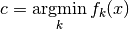
where
 correspond to the rejection class (i.e.,
  )
only when the maximum taken over the other classes (excluding the
reject one) is not greater than the reject threshold .
)
only when the maximum taken over the other classes (excluding the
reject one) is not greater than the reject threshold .If a preprocess has been specified, input is normalized before classification.
- Parameters
- xCArray
Array with new patterns to classify, 2-Dimensional of shape (n_patterns, n_features).
- return_decision_functionbool, optional
Whether to return the decision_function value along with predictions. Default False.
- n_jobsint, optional
Number of parallel workers to use for classification. Default _NoValue. Cannot be higher than processor’s number of cores.
- Returns
- labelsCArray
Flat dense array of shape (n_patterns,) with the label assigned to each test pattern. The classification label is the label of the class associated with the highest score. The samples for which the label is equal -1 are the ones rejected by the classifier
- scoresCArray, optional
Array of shape (n_patterns, n_classes) with classification score of each test pattern with respect to each training class. Will be returned only if return_decision_function is True.
-
property
threshold¶ Returns the rejection threshold.